
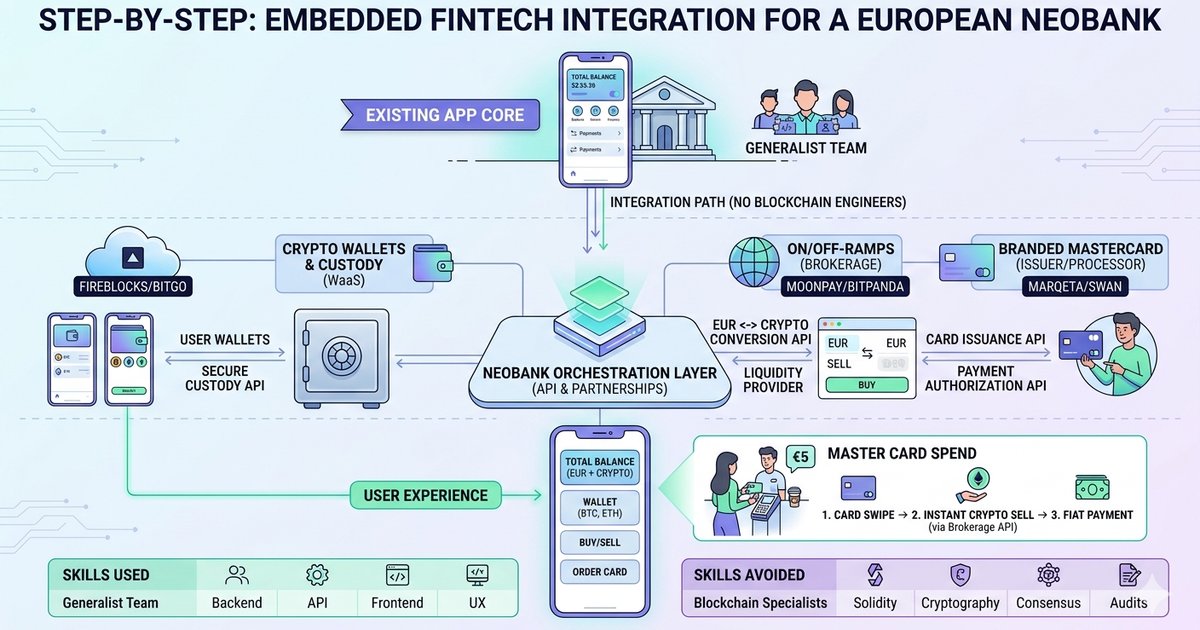
When a mid-sized European neobank approached us in Q4 2024, they had a clear goal: add crypto to their app before a competitor beat them to market. Their tech team was strong in fintech but had zero blockchain experience. Their timeline was aggressive — three weeks to a working integration, six weeks to production.
We made it happen. Here's exactly how.
Week 1: Architecture and Sandbox Integration
The first week was about understanding their existing infrastructure and mapping the integration points.
Their stack: a Node.js backend with a PostgreSQL database, a React Native mobile app, and an existing Visa prepaid card program via a European issuer. They already had KYC/AML flows for their fiat product.
Day 1–2: API keys and sandbox setup
We provisioned a sandbox environment within 24 hours. Their lead backend engineer made the first API call — creating a test Ethereum wallet — within 20 minutes of receiving the credentials.
import { BroLabel } from '@brolabel/sdk';

const client = new BroLabel({ apiKey: process.env.BROLABEL_API_KEY });

const wallet = await client.wallets.create({
  userId: 'user_123',
  chains: ['ethereum', 'bitcoin', 'polygon'],
});

console.log(wallet.addresses);
// { ethereum: '0x...', bitcoin: 'bc1...', polygon: '0x...' }
Day 3–5: Ledger and balance design
The critical design decision was how to map BroLabel wallet balances to their existing user model. We recommended a 1:1 wallet-to-user model with a BroLabel-managed ledger — meaning their backend didn't need to track crypto balances at all. The BroLabel ledger handled balance state, transaction history, and reconciliation.
Day 5–7: On/off-ramp integration
We connected their existing bank transfer infrastructure to BroLabel's on-ramp endpoints. A user initiates a bank transfer → their backend calls POST /v1/ramp/on → funds appear as crypto in the wallet within the settlement window.
Week 2: Mobile UI and Transaction Flows
With the backend integration in place, their mobile team built the UI.
Crypto balance screen: Pulls from GET /v1/wallets/{id}/balances which returns all chain balances with current USD values from our price feed.
Send crypto: A simple flow — enter recipient address, amount, confirm. Behind the scenes: POST /v1/transactions with the signing handled entirely by BroLabel's MPC infrastructure.
Receive crypto: Static address display with a QR code. No API call needed — the address is determined at wallet creation.
Transaction history: GET /v1/wallets/{id}/transactions returns a paginated, unified transaction history across all chains with human-readable descriptions.
The mobile team shipped a working prototype by end of Week 2. The entire crypto UI was approximately 1,200 lines of React Native code.
Week 3: BROcard Integration and Compliance
The most complex part wasn't the crypto — it was connecting crypto spending to their Mastercard program.
BROcard provisioning: When a user activates the crypto card, we provision a virtual Mastercard via BroLabel's card issuing API. The card is linked to the user's crypto wallet. When the user makes a purchase, the spend is deducted from their wallet balance at the live exchange rate.
AML/KYC pass-through: Since the neobank already had KYC on all users, we integrated their KYC status via a webhook. Users with approved KYC automatically get crypto wallets enabled. No double-KYC friction.
Transaction monitoring: We connected BroLabel's webhook system to their compliance team's monitoring dashboard. Every transaction — crypto send, card spend, on/off-ramp — fires a webhook event that their existing AML system can evaluate.
Going to Production
On Day 21, we moved to production with a controlled rollout to 500 beta users. The first real transaction happened within 4 minutes of launch.
Week 5: 5,000 active users, all crypto features stable. Week 6: Full production launch to 200K+ users.
What we learned: The biggest time-saver was not having to build the custody infrastructure. A typical blockchain engineering hire takes 2–3 months to onboard and produce production-quality code. By using BroLabel, the neobank's existing backend team handled the entire integration — no specialist knowledge required.
What's Possible in Three Weeks
If you're a fintech team considering adding crypto, here's what's achievable:
- Multi-chain wallet creation and management
- On-ramp from bank transfer or card
- Off-ramp to bank account
- Crypto-to-fiat card spending (Mastercard or Visa)
- Full transaction history and balance tracking
- Webhook events for your compliance stack
If you want to see the full technical integration guide, check our developer documentation.