
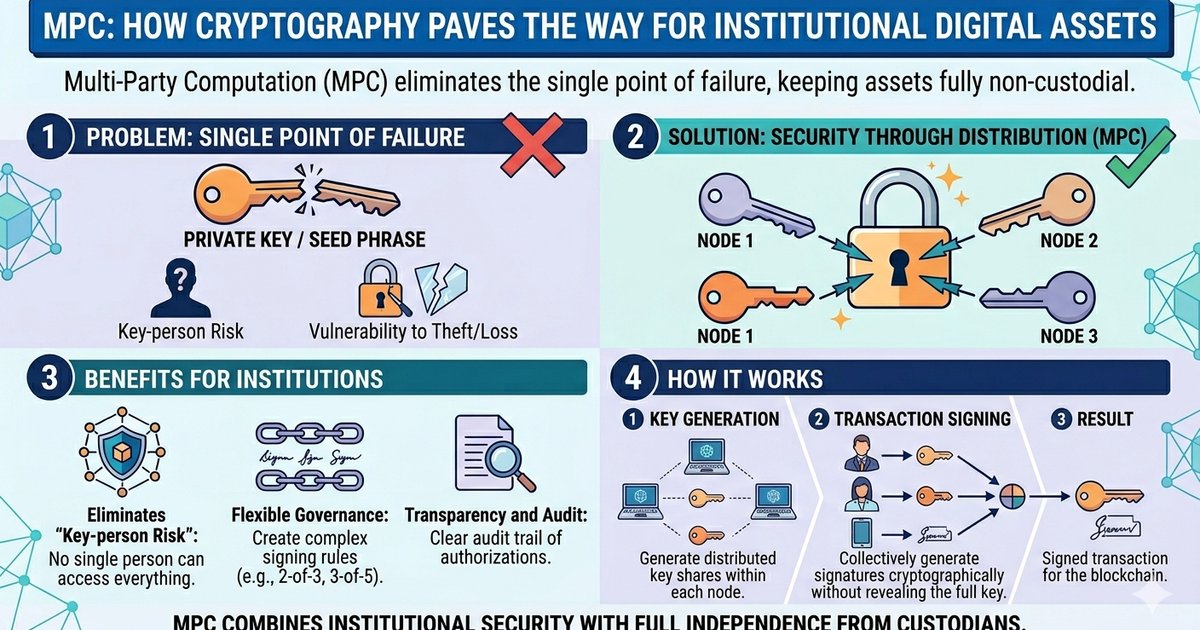
Seed phrases — the 12 or 24-word mnemonic phrases that back up a private key — were a brilliant invention when crypto was a hobbyist activity. Store it on paper, keep it offline, and you were secure. But as institutional capital entered the space, the limitations became impossible to ignore.
The Single Point of Failure Problem
A seed phrase is the master key. Whoever holds it owns the funds. For an individual, this is a reasonable trade-off. For an organisation managing $100M+ in digital assets, it creates an existential risk:
- Insider threat: A single employee with access to the seed can drain the vault
- No access controls: You can't grant "sign transactions up to $10,000" permissions
- No audit trail: You can't tell which team member initiated a transfer
- Operational risk: The person holding the key gets hit by a bus, and assets are gone
Traditional hardware wallets helped, but they didn't solve the institutional problem — they just made the seed phrase harder to steal.
How MPC Changes the Equation
Multi-Party Computation (MPC) is a cryptographic technique where a private key is never assembled in one place. Instead, the key is split into mathematically related shards distributed across multiple parties. A transaction is signed when a threshold of shards cooperate — for example, 2 out of 3.
The key insight: the private key never exists as a whole, not even for a millisecond during signing.
This changes the security model fundamentally:
| Property | Seed Phrase | MPC |
|---|---|---|
| Single point of failure | ✅ Yes | ❌ No |
| Fine-grained access controls | ❌ No | ✅ Yes |
| Audit trail | ❌ No | ✅ Yes |
| Threshold signing | ❌ No | ✅ Yes |
| No hardware dependency | ✅ Yes | ✅ Yes |
Threshold Signature Schemes (TSS)
The specific variant used in production custody infrastructure is called Threshold Signature Scheme (TSS). Unlike earlier MPC approaches that required multiple rounds of communication, modern TSS protocols (GG20, CGGMP21) can produce a valid ECDSA or EdDSA signature in a single round with low latency.
At BroLabel, we implement TSS at the core of our BROsettlement product. Each wallet is protected by a configurable threshold policy — for example, 2-of-3 shards with one shard held by the client, one by BroLabel's HSM cluster, and one in cold storage.
Regulatory Implications
Regulators are increasingly recognising MPC as best practice. The EU's MiCA regulation and FATF's updated guidance on Virtual Asset Service Providers (VASPs) both implicitly favour custody architectures with:
- Segregated client assets
- No single point of failure
- Demonstrable access controls and audit trails
MPC wallets check all three boxes. Seed phrases check none.
The Developer Experience
One concern we hear often: "MPC sounds complex — is it hard to integrate?"
With modern infrastructure APIs (like BroLabel's), the answer is no. Creating an MPC wallet is a single API call:
POST /v1/wallets
{
  "chain": "ethereum",
  "policy": { "threshold": 2, "parties": 3 }
}
The complexity lives in the infrastructure layer. Your application sees a standard wallet address and signs transactions via the API — no cryptographic knowledge required.
What's Next for Wallet Security
The next frontier is account abstraction combined with MPC — where smart contract wallets gain programmable spending rules (daily limits, multi-approval workflows, time-locks) while still using MPC for key management. This is where the industry is headed, and it's what BroLabel is building toward.
If you're building a product that touches user funds, the question is no longer whether to use MPC — it's which MPC infrastructure to build on.